

|
|
|
|
|||||||
|
|
|
|
|
|
The Lowest Common Denominator “Contrary to the argument put by some that political campaigning would be debased under voluntary voting (an argument again based on the largely irrelevant US experience), former ALP pollster and campaign strategist Mr Rod Cameron has expressed the view that voluntary voting would result in a greater focus on mainstream issues, as parties could not afford to concentrate on scaring swinging voters away from their opponents.
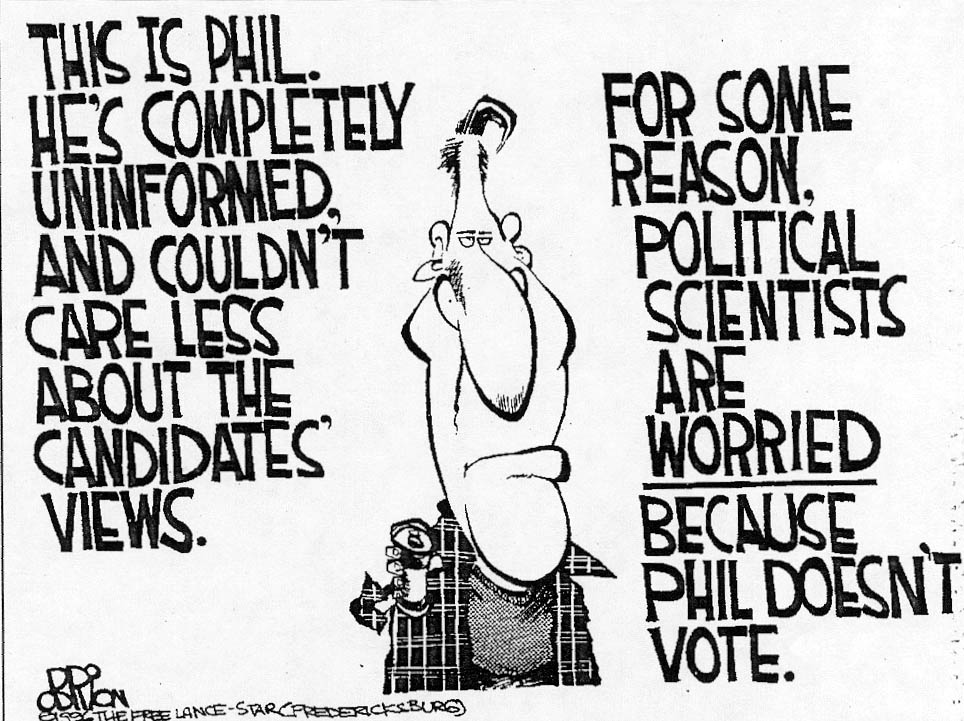
“the publisher and newspaper columnist, Peter Ryan, took this further, seeing compulsory voting as trivialising campaigns. He claimed, for example, that the 1984 election produced no real discussion of national problems: Ryan concluded: ‘That’s what you get from compulsory voting.’”3Those ‘morons’ who don’t know or don’t care The late Australian Senator Don Chipp once referred to non-voters as ‘morons’4. This might be rather a rash and unfair judgement. Although the term may be somewhat justifiable for someone who believes a change of government in an upcoming election will have serious ramifications for the country and yet still doesn’t bother to vote, not all non-voters fall into this category. The motive for many who don’t vote could be that they are intelligent enough to know that their input into a decision making process in a subject they know next to nothing about would not only be useless, but possibly even harmful. Nevertheless, in the subject of civics and government, the undeniable truth is that many people of voting age do fall into this asinine category. There are houses in Parliament? In 1994 ANOP Research Services Pty Ltd conducted a national survey to ascertain Australians understanding of government.
Britain has a history? In 2009 Professor Derek Matthews was so surprised to discover that the students in his economics class at Cardiff University had such a poor grasp of British history that he decided to conduct an experiment. He set five easy questions, which he believed 'every 18-year-old should know', and over three years 284 first-year university students took the test. Noting that his students were in the top 15 per cent of their age group for educational success, the results to the following questions were rather surprising. 1. Who was the general in charge of the British Army at the battle of Waterloo?
Only 16.5% could name the Duke of Wellington in response to question #1 while not more than 34.5% could name Queen Elizabeth I for the time of the Spanish Armada. 89% could not pick any Prime Minister out of the long list including Gladstone, Disraeli, The Duke of Wellington (again), Sir Robert Peel or William Pitt the Younger, and 70% could not place the Boer War in South Africa. What perhaps says more for the teaching of the real as opposed social sciences in modern day UK, the highest score, albeit still a minority, correctly identified Isambard Brunel as an engineer10.
There’s been more than two centuries? In the fall of 2005, the University of Connecticut's Department of Public Policy conducted a survey of students' learning in key fields needed to prepare them to be informed citizens. They asked college students, some 14,000 freshmen and seniors at 50 colleges and universities across the country, 60 multiple-choice questions in order to measure their knowledge in four subject areas: (1) American history; (2) government; (3) America and the world; and (4) the market economy. Responses from college seniors to a selection of individual questions display how little they actually know about basic historical facts, ideas, and concepts germane to meaningful participation in American civic life.
Like, where is America? In 2002 the National Geographic Society did a survey of Americans aged eighteen to twenty-four. Amongst other results it found that on being shown a world map:
The donkey vote actually has two interpretations. In one it is the vote from someone forced to the polling booth, and during the time they are waiting in line, makes their choice for the simplest of reasons. The alternative is the voter who consciously refuses to make even the most rudimentary deliberation, and votes in the manner which will have him or her back out the door after performing their obligation the quickest: ticking the boxes in sequential order from top to bottom, that is “1,2,3,4,5” In justifying compulsory voting, claims have been made that only the complete population’s vote can give an accurate picture of the electorate’s view. The irony of this claim is that in Australian elections, when votes are counted in marginal single member seats (electorates where there is almost equal support for both parties) half the time the final tally gives a false result because of compulsory voting. It is estimated that the donkey vote accounts for between one half to one per cent of the total vote8. This can simply be estimated by counting “1,2,3,4,5” ballot papers from previous elections and subtracting those, if there were any, where a candidate actually advocated that order of voting for Thus for any electorate where the final winning margin is below 0.5% it would be reasonable to deduce that if the winner’s name had been allocated higher on the ballot paper than the runner up, then he /she would have won the election only due to the help of the estimated at least half percent donkey vote. Judging from previous results it has been estimated by Melbourne’s The Age newspaper that in the 2010 Australian Federal Election eight seats will fall into this category of having a less than 0.5% margin and sixteen less than one per cent9. Thus we are to expect probably between four and eight members of the House of Representatives who do not represent the majority of their constituents who gave even the most limited consideration before voting. |
|
|
|
1‘Report of the Inquiry into the Conduct of the 2004 Federal Election and Matters Related Thereto’, Joint Standing Committee on Electoral Matters, October 2005, p.189.
|
|
|
| [Home] [A Duty?] [About Us] [FAQ] [Donkey Vote] [Links] |







 Mr Cameron informed a Senate select committee that if you did not have compulsory voting, you would have a higher level of political debate and political advertising generally because you could actually talk policy.
 his supporters.